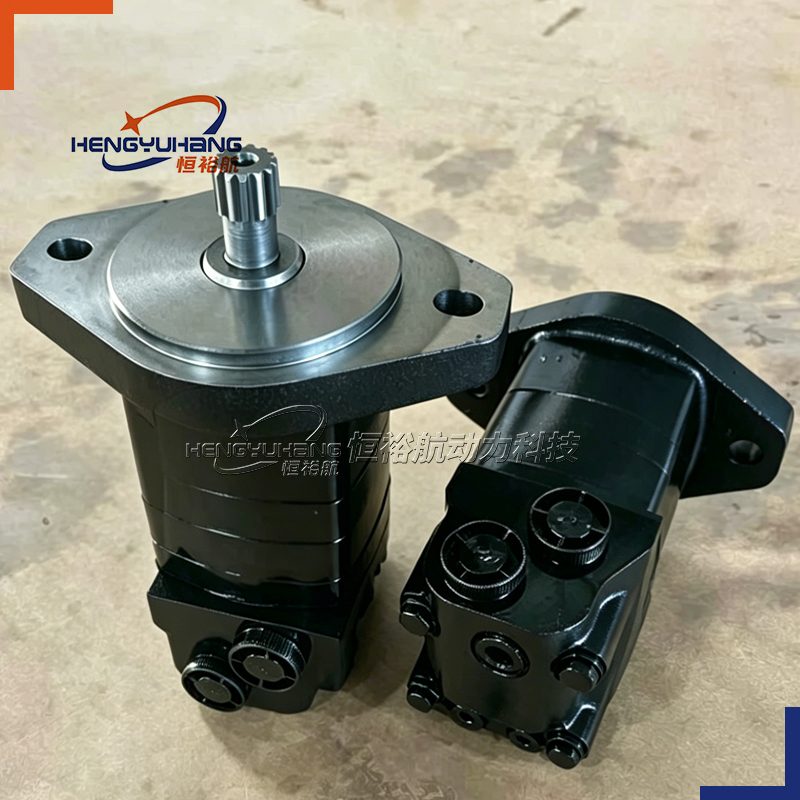
Everything you need to know about cycloidal motors
1.What Is a Geroler Orbital Motor?
Geroler orbital motors, also known as cycloidal hydraulic motors, are compact positive-displacement components designed to convert hydraulic energy into mechanical rotational power. Its main features are low rotational speed and high torque., eliminating the need for additional gearboxes in most applications.
Inside the motor, a precision-machined geroler gear set and disc valve work together to create smooth, continuous rotation. This structure allows the motor to operate efficiently even under heavy loads, making it ideal for machinery that requires reliable, low-speed power output.
2.Core Working Principle
Unlike centrifugal pumps that rely on velocity to move fluid, geroler motors operate on a simple positive-displacement principle:
(1.)Pressurized hydraulic oil enters the motor’s chambers.
(2.)The oil pushes against the geroler gear set, causing it to rotate in a planetary motion.
(3.)This motion drives the output shaft, converting hydraulic pressure into mechanical torque.
(4.)Oil exits the motor, completing the cycle.
This process creates a consistent flow rate directly proportional to the motor’s speed and displacement. As a result, geroler motors maintain steady torque output regardless of minor pressure fluctuations, ensuring stable equipment performance.
3.Common Applications of Cycloidal (Geroler Orbital) Motors
Cycloidal motors are widely used across industries that require compact, reliable, low-speed high-torque power solutions. Here are their most common applications:
(1.) Construction Machinery
Skid steer loaders (drive wheels, augers, and attachments)
Concrete mixers (rotating the mixing drum)
Road sweepers (powering the broom system)
Excavator attachments (augers, mowers, and compactors)
Backhoe loaders (auxiliary hydraulic drives)
(2.) Agricultural Equipment
Tractors (reel drives, augers, and hay balers)
Harvesters (header drives and grain augers)
Sprayers (boom drives and pump systems)
Hay balers and round balers (rotating the bale chamber)
Agricultural winches and reel systems
(3.)Material Handling & Industrial
Forklifts and pallet trucks (drive wheels and lift mechanisms)
Aerial work platforms (auxiliary drives and stabilizers)
Conveyor systems (low-speed belt drives)
Hydraulic winches (lifting and pulling heavy loads)
Drilling rigs (rotating drill bits)
(4.) Municipal & Special Vehicles
Street sweepers (brush and wheel drives)
Snow plows and salt spreaders (augers and spreader mechanisms)
Refuse trucks (compactor and lift systems)
Marine equipment (winches, capstans, and anchor drives)
Utility vehicles and forestry machinery
4.Common Cycloidal Motor Problems and Troubleshooting Guide
(1.)Excessive Noise During Operation
Possible Causes:
Insufficient lubrication
Worn cycloidal discs
Damaged needle bearings
Misalignment during installation
Solutions:
Check and replace lubricating oil regularly
Inspect internal components for wear
Verify shaft alignment
Replace damaged bearings
(2.)Motor Overheating
Possible Causes:
Overloading
Poor ventilation
Excessive friction
Low lubricant levels
Solutions:
Reduce operating load.
Improve cooling and airflow.
Check lubrication conditions.
Inspect internal components for damage.
(3.)Oil Leakag
Possible Causes:
Damaged oil seals
Excessive internal pressure
Improper installation
Aging gaskets
Solutions:
Replace oil seals
Check vent plugs
Inspect sealing surfaces
Use manufacturer-recommended lubricants
(4.)Reduced Output Torque
Possible Causes:
Worn cycloidal gears
Damaged bearings
Excessive backlash
Input shaft issues
Solutions:
Replace worn transmission components
Check gear engagement
Inspect the drive shaft and couplings
(5.)Excessive Vibration
Common Causes:
Shaft misalignment
Unbalanced loads
Bearing failure
Loose mounting bolts
Solutions:
Realign shafts
Balance the load distribution
Tighten mounting hardware
Replace defective bearings
5.Advantages & Disadvantages of Cycloidal (Geroler Orbital) Motors
(1.)Advantages
Excellent low speed and high torque output.
Compact structure, easy to install in limited space.
Smooth operation with low vibration and noise.
Simple internal design, low failure rate and easy maintenance.
Strong adaptability to dusty, humid and other harsh working environments.
Direct replacement for mainstream brand models without modification.
(2.)Disadvantages
Lower efficiency when running at high speed.
Not suitable for ultra-high pressure working conditions.
Slightly higher internal leakage than some other hydraulic motors.
6.How to Choose the Right Cycloidal (Geroler Orbital) Motor
(1.)Displacement & TorqueSelect the correct displacement according to your required torque and working load. Higher displacement provides greater low-speed torque.
(2.)Mounting & Shaft TypeConfirm flange type (2-bolt or 4-bolt SAE) and shaft style (tapered, keyed or splined) to ensure perfect installation without modification.
(3.)Port Size & ThreadMatch inlet, outlet and drain port thread size to fit your hydraulic pipeline.
(4.)Working Pressure & SpeedMake sure the motor’Make sure that the pressure and speed range of the motor is in line with the operating conditions of your equipment.
(5.)Seal MaterialChoose standard NBR seals for normal environments or Viton seals for high temperature and special oil conditions.
(6.)Original Part NumberThe fastest way is to replace directly by OEM part number (Eaton Char-Lynn or Danfoss M series).
7.How to maintain a cycloidal motor on a daily basis
Regularly inspect the hydraulic oil and replace the contaminated hydraulic oil in time.
Check if there is any oil leakage from the shaft seal. Replace worn seals immediately.
Keep the motor surface clean to avoid dust and dirt entering internal parts.
Check mounting bolts and pipe connections to ensure they are tight.
Avoid long-term overloading and overspeeding during operation.
Use matched seal kits for periodic overhaul to extend service life.
 WhatsApp
 Email
Email
 +86 19918575358