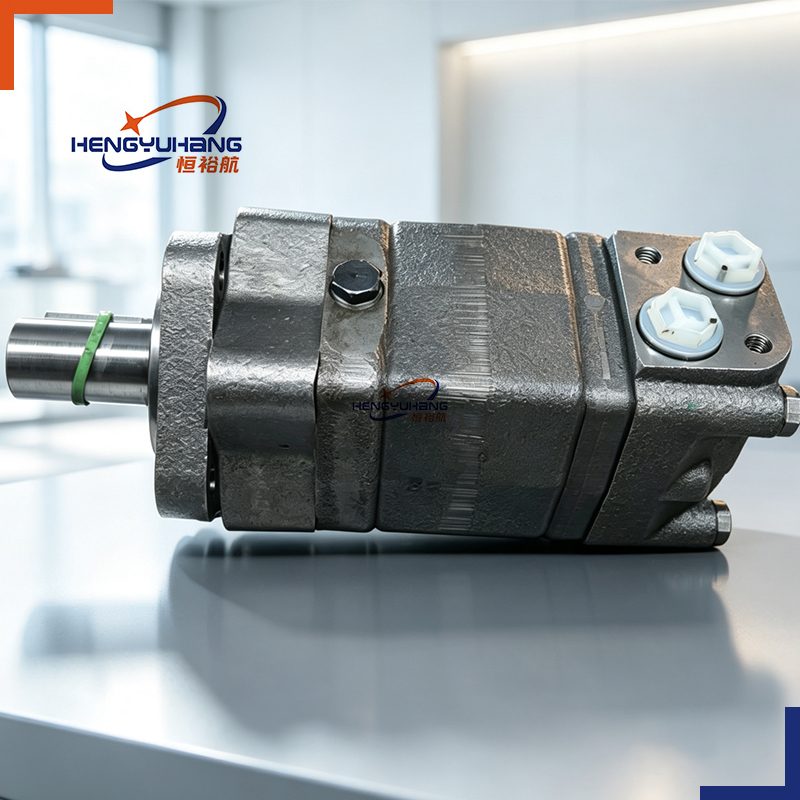
Eaton Hydraulic Motor: Comprehensive Overview, Product Range, Performance Advantages, Application Scenarios, Fault Diagnosis and Maintenance Guidelines
The Eaton hydraulic motor is the core actuating component of the Eaton fluid power system. It is widely used in fields such as construction machinery, agricultural machinery, special vehicles for environmental sanitation, mining equipment, and industrial hydraulic stations. It is a volumetric hydraulic actuating device that can convert the pressure energy of hydraulic oil into rotational mechanical energy, outputting torque and rotational speed. With advantages such as high torque density, stable operation at low speeds, strong shock resistance, and long service life, it is the mainstream preferred product in the global original equipment and after-sales replacement markets.
I. Working Principle of Eaton Hydraulic Motor
The Eaton hydraulic motors are mainly classified into three types based on their structure: the cycloidal track motor, the radial piston motor, and the axial piston motor. When high-pressure hydraulic oil enters the working chamber of the motor, it drives the core components such as the cycloidal rotor and the piston group to complete the rotational motion, and the oil on the low-pressure side returns to form a continuous rotary output. The cycloidal motor is mainly designed for low-speed and smooth operation, while the piston motor is suitable for heavy-load, high-pressure, and high-torque working conditions.
Eaton's exclusive pressure balance structure and wear-resistant coating and other patented designs significantly reduce internal leakage. Even when the equipment frequently starts and stops, changes direction, or withstands impact loads, it can still stably output the rated torque.
II. Introduction to Main Product Lines
1.Char-Lynn Spiral Motor (101/103/104/105/106/110 Series)
The classic Charlin cycloidal motor is Eaton's most popular product line. It is compact in size, has a wide range of displacement, moderate pressure, and offers high cost-effectiveness. It supports various shaft types, flanges, and oil ports, and is suitable for medium and light load scenarios such as sanitation cleaning vehicles, small excavators, conveying systems, and agricultural machinery auxiliary transmissions. The global spare parts circulation is well-established, and the after-sales replacement is convenient.
2. Heavy-duty disc-flow cycloidal motor (H/S/T series)
The disc distribution oiling structure has higher oiling accuracy and stronger resistance to oil contamination compared to traditional cycloidal motors. It operates smoothly without crawling at extremely low speeds, making it suitable for low-speed high-precision driving scenarios such as winch equipment, small drilling rigs, and special engineering vehicles.
3. Radial piston hydraulic motor
For extreme heavy-duty conditions, the rated working pressure can reach over 300 bar, with extremely large torque output. It is compatible with large-scale mining machinery, port lifting equipment, pile drivers, and large-scale combine harvesters, enabling them to operate at full load for long periods.
4. Axial piston variable motor
The displacement can be dynamically adjusted. It will automatically adapt the torque and speed according to the load changes, reducing the system energy consumption. It is mainly used in high-end mobile construction machinery such as road rollers, asphalt pavers, and aerial work platforms.
III. Core Advantages
1. Low-speed stability operation: The cycloidal series can operate smoothly at a low speed of several dozen revolutions per minute without any crawling or shaking;
2. Strong anti-pollution ability: The precise wear-resistant paired structure is suitable for mild pollution hydraulic oil in construction sites, resulting in a lower failure rate in harsh conditions;
3. Modular customization is rich: You can choose spline / flat key shafts, wet braking assemblies, speed measurement interfaces, various flanges, and in situ replacement is possible without modifying the equipment structure;
4. Excellent impact resistance: Thickened housing + quenched internal parts can withstand frequent direction changes and sudden load impacts;
5. Comprehensive global after-sales service: The model standardization degree is high, spare parts are delivered quickly, and maintenance and protection costs are low.
IV. Limitations of the Product
1. Helical motors should not be operated under extremely high pressure for a long time. For heavy-load and high-pressure conditions, radial piston motors should be preferred.
2. The motor requires a hydraulic pump station for its operation and is not suitable for simple-structured, low-power fixed equipment.
3. If the hydraulic oil temperature remains excessively high for a long time, it will accelerate the aging of the seals. The oil temperature range must be strictly controlled on a daily basis.
V. Application Scenarios
Construction machinery: Small excavator traveling motor, road roller rotating motor, asphalt paver conveying drive motor;
Agricultural machinery: Harvester swath drive motor, sprinkler irrigation machine rotating mechanism, baling machine power motor;
Special sanitation vehicles: Sweeping vehicle side brush motor, garbage compaction mechanism drive assembly;
Industrial equipment: Hydraulic winch, conveyor line drive, winding machinery, metallurgical auxiliary transmission;
Mining and ports: Small mining equipment rotating mechanism, port container auxiliary drive device.
VI. Selection Guide
1. Prioritize torque and speed calculation: Select the model based on the torque requirements of the driven mechanism, and reserve a safety factor of 1.2-1.3 times for the rated torque;
2. Match pressure level: For normal medium-pressure conditions, choose the Lin-type cycloidal motor; for heavy-load high-pressure conditions, choose the radial piston motor;
3. Verify installation parameters: Confirm the shaft spline specification, flange hole position, oil port thread, and rotation direction to achieve direct replacement;
4. Select additional functions: For parking brake scenarios, choose the model with a wet brake; for speed measurement requirements, select the model with reserved speed measurement ports.
VII. Common Faults, Causes and Solutions
Fault 1: Insufficient torque, weak driving force
Causes: Severe internal component wear resulting in excessive leakage, clogged oil filter, and reduced viscosity of hydraulic oil;
Treatment: Replace the new hydraulic oil and filter, check the sealing performance of the pipelines, and replace the worn matching parts.
Fault 2: Unstable rotation, slow crawling
Causes: Air mixed into the hydraulic system, uneven wear of friction components, abnormal back pressure of return oil;
Treatment: Completely evacuate the air from the system, adjust the back pressure of return oil to the recommended range by the manufacturer, and repair the worn-out components.
Fault 3: Severe abnormal noise and vibration (body vibration)
Causes: Bearing damage, impurities entering the motor cavity, deviation in coaxiality between the motor and the driven equipment;
Treatment: Disassemble the machine for cleaning impurities, replace the bearings, and correct the installation coaxiality.
Fault 4: Oil leakage from the casing
Causes: Aging of the main shaft oil seal, cracking of the O-ring, uneven tightening of the end cover bolts;
Treatment: Replace the entire sealing kit, and evenly tighten the end cover bolts diagonally.
VIII. Daily Maintenance Standards
1. Before starting the machine, check the oil level, the condition of the oil, and whether the seals are leaking.
2. Replace the hydraulic oil and filters after 500-800 hours of operation to reduce particle wear.
3. Keep the oil temperature within 40-60℃. Do not allow long-term operation above 70℃.
4. Prevent air from entering the oil circuit to avoid cavitation damage to internal parts.
5. After a cumulative operation of 2000-2500 hours, disassemble and overhaul the machine, and replace the vulnerable parts in advance.
 WhatsApp
 Email
Email
 +86 19918575358