Eaton Vickers PVQ Series Piston Pump: Complete Guide to Models, Specs & Aftermarket Solutions
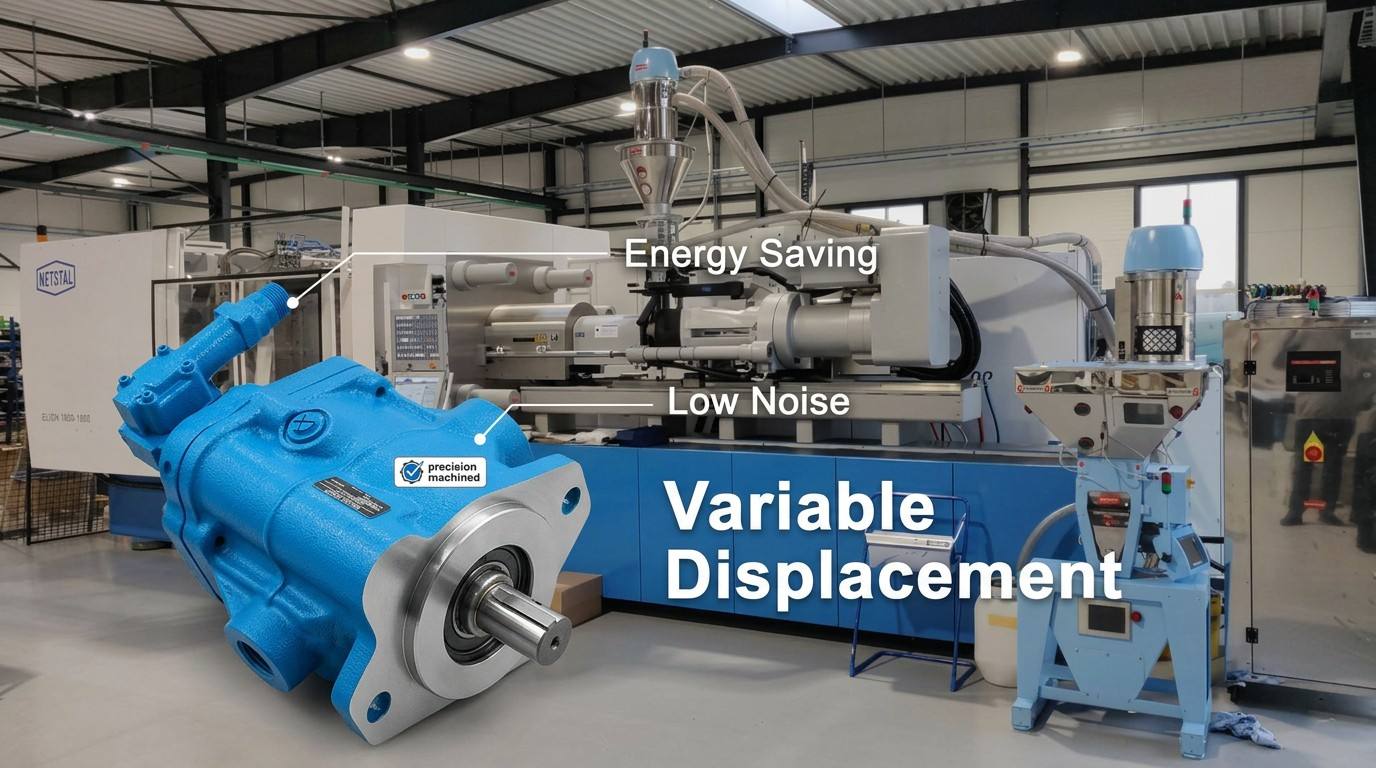
The Eaton Vickers PVQ series is a family of in-line, variable displacement axial piston pumps engineered for industrial hydraulic systems that demand quiet operation, compact packaging, and consistent performance. With seven displacement sizes ranging from 10.5 cc/rev to 45.1 cc/rev, the PVQ lineup covers a broad spectrum of flow requirements — from small machine tools to multi-station injection molding lines.
Originally manufactured by Vickers (now under the Eaton umbrella and subsequently Danfoss Power Solutions), the PVQ series earned a reputation for running at noise levels that rival or even fall below the electric motor driving them. This was achieved through a patented timing arrangement that smooths pressure transitions inside the pump, reducing hydraulic ripple — the primary source of pump noise.
Key takeaway: If your application requires a mid-pressure, variable-displacement piston pump that won't drown out conversation on the shop floor, the PVQ series was purpose-built for that role.
PVQ Series Model Breakdown: Sizes & Displacement
The full PVQ lineup spans seven core displacement sizes. Each model shares the same basic architecture but scales flow output to match different system demands.
| Model | Geometric Displacement (cc/rev) | Displacement (in³/rev) | Rated Speed (RPM) | Max Pressure (bar / PSI) |
|---|---|---|---|---|
| PVQ10 | 10.5 | 0.643 | 1,800 | 210 / 3,000 |
| PVQ13 | 13.8 | 0.843 | 1,800 | 210 / 3,000 |
| PVQ20 | 20.5 | 1.25 | 1,800 | 210 / 3,000 |
| PVQ25 | 25.0 | 1.53 | 1,800 | 210 / 3,000 |
| PVQ32 | 32.8 | 2.00 | 1,800 | 210 / 3,000 |
| PVQ40 | 41.0 | 2.50 | 1,800 | 210 / 3,000 |
| PVQ45 | 45.1 | 2.75 | 1,800 | 210 / 3,000 |
Note: Some catalogs also reference PVQ16 and PVQ63 variants depending on regional availability.
How to Read a PVQ Model Code
A typical PVQ model code looks like this: PVQ20-B2R-SS3-S20-CG20. Each segment maps to a specific configuration option:
PVQ20 — Pump series and displacement size
B — Control type (pressure compensator, load sensing, etc.)
2R — Rotation direction (right-hand or left-hand)
SS3 — Shaft configuration
S20 — Port arrangement
CG20 — Seal material and fluid compatibility
Always match the full model code when sourcing a replacement — even a single character difference can mean incompatible mounting, control logic, or fluid compatibility.
Why the PVQ Series Stands Out: 5 Key Advantages
1. Exceptionally Quiet Operation
The patented timing arrangement inside PVQ pumps is not a marketing gimmick. By optimizing the transition between high and low-pressure zones within the rotating group, Vickers engineers reduced the pressure pulsation that causes hydraulic noise. In many installations, the pump's acoustic signature is lower than the electric motor that drives it — a significant advantage in noise-sensitive environments like plastics processing and medical equipment manufacturing.
2. Broad Hydraulic Fluid Compatibility
PVQ pumps are not picky about what runs through them. They handle:
Petroleum-based hydraulic oils (mineral oil)
Synthetic fluids (phosphate esters, polyol esters)
Water-glycol solutions (fire-resistant fluids)
Water-in-oil emulsions
This flexibility means you can standardize on one pump series across multiple machines with different fluid requirements — simplifying maintenance and reducing spare parts inventory.
3. Thru-Drive Configuration
Multiple PVQ models can be ordered in a thru-drive configuration, where a coupling adapter mounts a second pump — fixed or variable displacement — to the rear of the primary PVQ unit. This creates a compact tandem package driven by a single electric motor, eliminating the cost and space of a second motor, coupling, and bell housing.
Common tandem combinations:
PVQ + fixed gear pump (for pilot/charge circuits)
PVQ + variable vane pump (for independent auxiliary circuits)
PVQ + PVQ (dual variable circuits from one motor)
4. Multiple Control Options
Displacement on a PVQ pump is varied via pressure compensator and/or flow compensator controls. Available control configurations include:
Pressure compensation (constant pressure beyond setpoint)
Flow compensation (constant flow regardless of load)
Load sensing (pressure and flow adapt to actual demand)
Combined pressure/flow compensation
Remote pressure control capability
This gives system designers the flexibility to optimize energy efficiency — only generating the flow and pressure the system actually needs, rather than wasting energy across a relief valve.
5. Compact, Serviceable Design
Weighing as little as 16 lbs (7.2 kg) for the PVQ10 and topping out at approximately 45 lbs (20.6 kg) for the PVQ45, the PVQ series packs substantial hydraulic power into a small footprint. The design uses a bell-shaped housing and bimetal timing plate that improves pump filling and extends service life — and when maintenance is required, the straightforward construction simplifies disassembly and rebuild.
Industries & Equipment Powered by PVQ Pumps
| Industry | Typical Equipment |
|---|---|
| Plastics Machinery | Injection molding machines (primary), blow molders, extruders |
| Metal Processing | Metal injection molding (MIM) presses, small hydraulic presses, shears, press brakes, CNC clamping & tool changer systems |
| Industrial Automation | Conveyor lines, automated assembly lines, lift platforms |
| Marine & Offshore | Ship propulsion systems, steering gear, anchor winches, subsea equipment hydraulic power units |
| Construction Machinery | Mini excavators, skid steer loaders, wheel loaders (auxiliary circuits) |
| Mining / Oil & Gas | Mining auxiliary hydraulic systems, oilfield hydraulic power units |
OEM vs. Aftermarket PVQ Pumps: What to Consider
Eaton (now Danfoss) has progressively discontinued or limited production of many PVQ models, particularly older configurations. This creates a dilemma for maintenance teams:
The OEM Route
Genuine Danfoss/Eaton units — where still available
Long lead times (often 8–16 weeks)
Premium pricing
Exact form/fit/function match
The Aftermarket Route
Direct drop-in replacements from specialized manufacturers
Shorter lead times (typically 2–4 weeks)
30–50% cost savings vs. OEM
Engineering support for model code cross-referencing
Equivalent or better warranty coverage
What to Look for in an Aftermarket PVQ Supplier
ISO 9001 certification — baseline quality management
Performance test reports — every pump should ship with a documented test curve (flow vs. pressure, volumetric efficiency)
Full model code matching — the supplier should verify your exact model code before shipping
Warranty — minimum 12 months; top-tier suppliers offer 18–24 months
Technical support — can they help you cross-reference an obsolete or partially illegible model code?
Common PVQ Failure Modes & Troubleshooting
| Symptom | Likely Cause | Action |
|---|---|---|
| Gradual loss of flow/pressure | Worn rotating group (piston shoes, barrel face) | Check case drain flow; if >10% of rated flow, rebuild or replace |
| Sudden pressure loss | Broken compensator spring or stuck spool | Inspect compensator assembly; flush contamination |
| Excessive noise | Cavitation, aeration, or timing plate wear | Check inlet strainer, fluid level, and viscosity; inspect timing plate |
| Overheating | Internal leakage through worn clearances | Measure case drain temperature rise; rebuild or replace if >15°C above reservoir |
| External oil leak | Shaft seal failure | Replace shaft seal; check for shaft misalignment or excessive radial load |
PVQ Replacement: Step-by-Step Checklist
Record the full model code from the pump nameplate (e.g., PVQ20-B2R-SS3-S20-CG20)
Note mounting flange type (SAE A 2-bolt is standard for most PVQ sizes)
Document port sizes and locations (SAE straight thread, rear/side port configuration)
Identify control type — pressure compensator, flow compensator, or load-sensing
Check shaft dimensions — diameter, keyway, spline if applicable
Confirm rotation direction when viewed from shaft end
Verify fluid type — especially if running water-glycol or phosphate ester
Cross-reference your model code with your aftermarket supplier before ordering
Why Source Your PVQ Pump from HYH Hydraulics?
As a specialized hydraulic pump and motor manufacturer serving the construction equipment and industrial aftermarket, HYH Hydraulics offers:
Full PVQ series coverage — PVQ10 through PVQ45, pressure-compensated and load-sensing configurations
Pre-shipment performance testing — every pump ships with a documented flow/pressure/volumetric efficiency test report
Model code cross-referencing — send us your existing pump's code and we'll verify the exact match
Competitive lead times — typically 2–4 weeks for standard configurations
Technical support — engineers who speak hydraulics, not just part numbers
Need a PVQ replacement or have a cross-reference question? Contact our team with your model code for a quick quote.
Disclaimer: Eaton, Vickers, and Danfoss are registered trademarks of their respective owners. HYH Hydraulics is an independent aftermarket manufacturer and is not affiliated with or endorsed by Eaton Corporation or Danfoss Power Solutions.
 WhatsApp
 Email
Email
 +86 19918575358