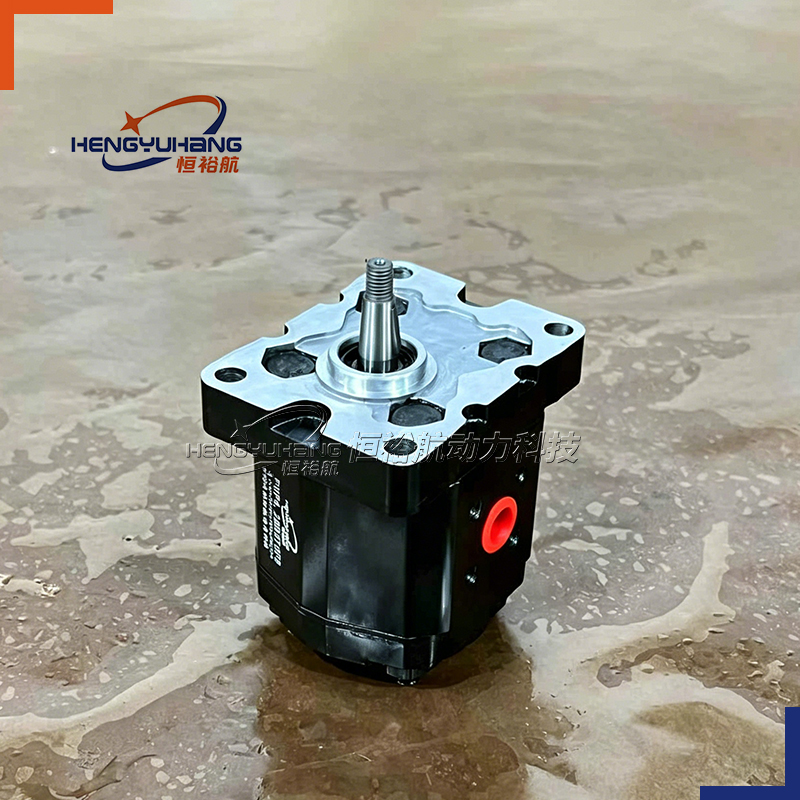
The information you need to know about gear pumps
1.What Is a Hydraulic Gear Pump
A gear pump is a type of positive displacement hydraulic pump with a fixed displacement. It converts the mechanical energy from an engine or an electric motor into a stable flow of hydraulic oil, and is widely used in agricultural machinery and industrial machinery.
Core principle: The gear pump only generates the oil flow. The pressure in the system is generated by the load resistance, not by the gear pump itself.
2.Working Principle of Hydraulic Gear Pump.
Two intermeshing gears rotate within the same sealed pump housing. The oil is discharged and drawn in through the gears. The separated gear teeth draw the oil in at the inlet, and the re-engaged gear teeth then discharge the oil at the outlet, thus forming a continuous hydraulic oil.
(1.)Oil suction operation
At the inlet, the gear teeth separate and expand the sealed tooth cavity, creating a negative pressure that draws the hydraulic oil into the tooth gaps.
(2.)Oil transportation
The oil is sealed within the tooth slots and flows along the inner wall of the pump casing towards the outlet end. It is isolated through the gear meshing line to prevent backflow.
(3.)Oil discharge operation
At the outlet end, the gear teeth mesh tightly, compressing the volume of the tooth cavity and forcing the oil out to form a continuous hydraulic oil.
3.Common Applications of Hydraulic Gear Pumps
Construction Machinery
Excavator pilot & steering auxiliary hydraulic system
Skid steer loaders, compact road rollers
Concrete mixers and road sweepers
Agricultural Equipment
Tractor steering hydraulic units
Harvesters, crop sprayers, hay balers
Farm irrigation hydraulic power sets
Municipal & Sanitation Vehicles
Street sweepers, snow plows
Refuse trucks, waste compactor systems
Industrial Mini Hydraulic Units
Small hydraulic power packs
Lifting platforms, material conveyor drives
Light-duty machine tool auxiliary circuits
Other Scenarios
Forklifts, marine small hydraulic systems, garden machinery hydraulic drives
4.Key Components of Hydraulic Gear Pump
(1.)Gearset (driving gear + driven gear)
This is the core component. Through the rotation of meshing gear teeth, the volume of the chamber is changed, thereby discharging and drawing in the oil.
(2.)Pump housing
Sealed structure, which can protect the internal gears and facilitate installation.
(3.)Bottom cover
Seals the ends of the outer casing, installs bearings, and separates the suction chamber and discharge chamber.
(4.) Shaft and bearings
Ensures smooth operation of the gears, reduces friction and prevents gear wear.
(5.)Sealing components (shaft oil seal, O-ring)
Prevents internal oil leakage and prevents dust from entering the pump.
(6.)Floating side plate (high-pressure gear pump)
Automatically adjusts the gap between the gears, reduces internal leakage, and improves efficiency.
5.Common Faults & Solutions of Hydraulic Gear Pump
(1.) Oil leakage
Reason: Aging of the shaft seal, damaged O-ring, loose cover bolts, uneven connection surface of the housing
Solution: Replace the damaged or aged sealing components, retighten all bolts, and smooth the connection surface of the housing
(2.)Insufficient flow and low machine power
Reason: Severe internal leakage, worn gear teeth, clogged oil suction filter, air entering the oil circuit
Solution: Clean or replace the filter, replace worn gear teeth, seal all oil suction pipe joints to prevent air entry
(3.) Abnormal noise and vibration
Reason: Air mixed into the hydraulic oil, damaged bearings, worn gear teeth, insufficient oil quantity, loose fixed bolts
Solution: Clean blocked oil pipelines, replace worn bearings and gear teeth, replenish hydraulic oil to the standard quantity, and tighten all pump bolts
(4.)High temperature of the gear pump
Reason: Long-term overloading, severe internal leakage, contaminated oil, poor heat dissipation
Solution: Reduce continuous overloading operation, replace worn gear or sealing components, replace hydraulic oil and clean filters, clean the pump surface dust, improve heat dissipation effect
(5.)No oil output after startup
Reason: Reverse rotation direction of the pump, empty oil tank, clogged oil suction filter, broken transmission key
Solution: Adjust the rotation direction of the pump, add standard amount of oil to the oil tank, clean the filter, replace the damaged transmission key
(6.)Rapidly worn gears and short service life
Reason: Dirty oil containing metal impurities, overloading operation
Solution: Use high-precision filters, regularly replace hydraulic oil, match pump pressure and system load
6.Advantages and Disadvantages of Hydraulic Gear Pump
Advantages:
The overall structure is simple and compact; the manufacturing cost is low, and installation and maintenance are easy.
It has strong anti-pollution performance against oil stains and impurities. It can still operate stably even in dusty and harsh working environments.
It is small in size and easy to install on mechanical devices with limited space.
It can stably output flow even under medium and low pressure, and has a low failure rate in light-load hydraulic systems.
Disadvantages:
The flow rate is fixed and cannot be automatically adjusted according to the load.
It has severe leakage in high-pressure environments and low efficiency.
It generates significant noise and vibration at high speeds.
It is not suitable for ultra-high pressure precision hydraulic equipment.
7.How to Select the Right Hydraulic Gear Pump
(1.)Determine the required displacement and flow rate
Calculate the flow rate your equipment requires and select the corresponding displacement model.
(2.)Match the working pressure
Check the working pressure and peak pressure of the system. Choose the pump rated pressure that is higher than the actual working pressure to extend the service life.
(3.)Installation dimensions
Confirm the type of installation flange, shaft, diameter of the shaft, and the size of the interface threads. Ensure they match the original installation position without any other modifications.
(4.)Rotation direction
Determine whether it rotates clockwise or counterclockwise based on the power output direction. Incorrect direction will result in no oil output.
(5.)Select the appropriate sealing material
For ordinary hydraulic oil, use NBR material for the sealing parts. For high-temperature environments or synthetic oil, use Viton sealing parts.
(6.)Consider the working environment
For long-term overloading operation, use a pump with a floating side plate. This can reduce internal leakage and improve efficiency.
8.Daily Maintenance of Hydraulic Gear Pump
(1.)Maintain the cleanliness of the hydraulic oil
Regularly replace the hydraulic oil and clean the filters. Do not mix it with dirty oil to avoid damage to the gears.
(2.)Regularly check for leaks
Inspect the shaft seals, O-rings and ports to see if there is any oil leakage. If there are aged or worn seals, replace them promptly.
(3.)Strengthen connections
Regularly check the bolts and pipe interfaces of the pump to prevent air from entering and leakage from occurring.
(4.)Avoid improper operation
Do not operate the pump for a long time with excessive load. Reduce gear wear.
(5.)Clean the surface of the pump
Clean the dust on the surface of the pump to ensure the heat dissipation effect.
(6.)Regular maintenance
After long-term use, regularly check if any components are damaged.
 WhatsApp
 Email
Email
 +86 19918575358