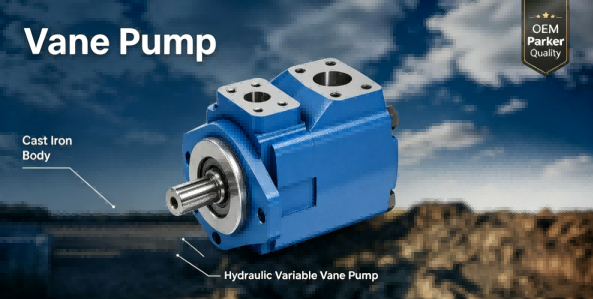
The information you need to know about vane pumps
1.What is a Vane Pump
The vane pump is a type of volumetric hydraulic pump. It operates by having the flexible vanes in the rotor slot tightly adhere to the curved surface of the stator and rotate, thereby changing the volume of the enclosed space formed by the vanes, the rotor, and the stator. This process enables oil suction and pressure application. It is commonly used in medium and low-pressure hydraulic systems, featuring low noise and uniform flow.
2.Working Principle of Vane Pump
Basic Principle
The vane pump is composed of a rotor, vanes, stator, flow distributor plate, and pump body. The rotor has radial grooves, and the vanes placed in the grooves can freely slide; the rotor rotates at high speed along the drive shaft, and the centrifugal force pushes the vanes outward, tightly adhering to the curved surface of the stator. An independent and sealed oil cavity is formed between adjacent vanes, rotor, stator, and flow distributor plate.
When the rotor continues to rotate, the volume of the sealed oil cavity periodically increases and decreases, thereby completing the oil suction and pressure oil circulation.
1. Double-acting vane pump (constant flow rate, most commonly used in industry, with elliptical inner cavity of the stator)
Suction stroke: As the rotor rotates, the vanes extend outward along the long axis of the stator, causing the volume of the sealed oil chamber to continuously expand, creating a negative pressure. Hydraulic oil enters the oil chamber through the suction window of the flow distributor.
Suction and pressure stroke: As the rotor passes through the elliptical short-axis region, the vanes are squeezed back into the rotor groove by the inner wall of the stator, causing the volume of the oil chamber to rapidly contract. The oil is pressurized and is output through the pressure outlet window of the flow distributor.
Key features: For each rotation of the rotor, it completes 2 suction and 2 pressure strokes. The suction and pressure zones are symmetrical, the radial force on the rotor is completely balanced, and the bearing loss is smaller. The flow rate is stable without pulsation, and the displacement is fixed and cannot be adjusted.
2. Single-acting vane pump (variable flow rate, stator is circular, rotor has an eccentricity with the stator)
Suction and pressure: The center of the stator and the center of the rotor are offset by an eccentric distance. As the rotor rotates, the oil chamber expands during one half of the rotation for suction, and shrinks during the other half for discharge. Only 1 suction and discharge occurs per rotation.
Variable regulation logic: By moving the stator through the regulating mechanism, the eccentricity between the rotor and the stator is changed: the greater the eccentricity, the longer the stroke of the vanes, and the greater the pump displacement and output flow; when the eccentricity is zero, the flow is 0.
Key features: A unilateral high-pressure oil generates a radial unbalanced force, resulting in greater bearing load. The rated pressure is lower than that of the double-acting model.
Core operating points
The flow distributor is fixed on both sides of the rotor, separating the suction zone from the pressure zone to ensure that the suction and pressure chambers do not intermix. Some pumps have a pressure oil inside that assists in pressing the vanes, preventing the leakage caused by the vanes not tightly adhering to the stator at low speeds.
3.Key Components of Vane Pump
1. Rotor
The rotating component that rotates actively, connected through spline and drive shaft. The outer ring is evenly equipped with multiple radial sliding grooves for installing the blades; during rotation, it drives the blades to rotate synchronously, being the core component for motion transmission.
2. Blade
A thin strip-shaped sliding part, placed in the sliding grooves of the rotor. During operation, it is pushed out by centrifugal force and auxiliary oil pressure, closely adhering to the inner wall of the stator to create an independent sealed oil cavity; the wear resistance of the blade directly determines the service life of the pump, and it is usually made of wear-resistant alloy steel.
3. Stator
Outer ring fixed ring component:
For double-acting vane pump: The inner cavity of the stator has an elliptical contour, creating two suction and pressure strokes for the two wheels;
For single-acting vane pump: The inner cavity of the stator is a circular shape, and the entire stator can be moved to change the eccentricity with the rotor to achieve variable flow regulation.
4. Flow distributor
Placed at both ends of the rotor, the disc body is equipped with arc-shaped suction and pressure windows, precisely dividing the suction area and discharge area to ensure the orderly entry and exit of the oil in each sealed cavity, avoiding internal leakage of the oil circuit, and having very high precision requirements for the working surface.
5. Drive shaft
Transmits the torque from the motor or engine, driving the rotor to rotate. Usually, it is supported by bearings to bear the radial and axial loads, and an oil seal is installed at the shaft end to prevent oil leakage.
6. Pump housing
An external encapsulated housing, reserved for oil inlet and outlet ports as well as installation flanges, accommodating all internal components; the housing interior is equipped with positioning structures to fix the stator and flow distributor, maintaining the stability of component positions.
7. Bearing assembly
Supports the drive shaft and the rotor, reducing friction generated by high-speed rotation; for double-acting vane pump, the radial force is balanced, and the wear rate of the bearings is relatively lower.
8. Sealing kit
Includes main shaft frame oil seal, O-ring seals at various locations, and gaskets, sealing the shaft end and end cover gaps to prevent external oil leakage, and blocking the intrusion of external dust into the pump cavity.
9. Variable regulation mechanism (only for single-acting variable vane pump)
Includes springs, adjusting screws, pressure regulating pistons, etc. Pushing the stator to change the eccentric distance to complete the regulation of flow and pressure.
4.Common Applications of Vane Pump
1. Metal processing machine tools (core application scenarios)
CNC lathes, machining centers, grinding machines, milling machines, bending machines, shearing machines
Advantages: Low flow pulsation, low noise, ensuring smooth and precise feed and clamping actions of the machine tools.
2. Plastic injection molding equipment
Horizontal / vertical injection molding machines, blow molding machines, extruders, die-casting machines auxiliary hydraulic systems
The main pump is a double-acting quantitative vane pump, providing continuous and stable oil supply, suitable for mold opening, ejection, and holding pressure processes.
3. Automated light industry equipment
Automated production lines, hydraulic workholding fixtures, small presses, cutting machines, leather processing machinery
The equipment load is moderate, aiming for low noise and low cost, with the vane pump having outstanding cost performance.
4. Lifting and storage equipment
Small lifting platforms, stacker trucks, boarding bridges, simple hydraulic cargo elevators
Medium flow, medium low-pressure working conditions, small structure, easy installation.
5. Ships and small auxiliary machinery
Ship deck auxiliary hydraulic systems, small fishing vessel hydraulic equipment, air compressor matching hydraulic station
Quiet operation, suitable for the noise-sensitive cabin environment.
6. Hydraulic power units (hydraulic stations)
Machine tool matching hydraulic stations, laboratory test benches, micro power pump stations for automated equipment
Single-acting variable vane pumps can adjust the flow as needed, energy-saving and cost-effective.
7. Other general machinery
Food packaging machinery, rubber vulcanization equipment, printing machinery, textile hydraulic equipment
5.Common Faults & Troubleshooting of Vane Pump
1.Insufficient output flow, weak equipment operation
Fault causes
Impurities in the oil have worn the vanes, the inner curved surface of the stator, and the flow distributor. Internal leakage has significantly increased;
The oil suction pipeline leaks air, the oil level in the oil tank is too low, and air is sucked into the pump;
The oil suction filter is clogged, and the supply resistance is too high;
The unidirectional variable pump adjustment mechanism is stuck, and the eccentricity cannot be adjusted to the maximum;
The vanes are worn and shortened, unable to fully adhere to the inner wall of the stator, and the seal fails.
Solution
Replace the hydraulic oil and the complete set of filters, disassemble and replace the worn-out vanes, stators, and distribution plates;
Check the oil intake connector and oil seal, tighten the pipelines, and replenish the oil to the standard level;
Clean or replace the blocked oil intake filter, shorten the oil intake pipeline;
Disassemble and clean the variable spring and pressure regulating piston, repair the stuck regulating mechanism;
Replace with a brand-new standard-length vane assembly.
2. Abnormal running sounds and severe vibrations
Fault causes
Air was mixed into the oil, causing an air erosion whistling sound;
The vanes broke and fragments hit the stator;
The bearing wore out with excessive clearance, causing the transmission shaft to shake;
The oil intake resistance was too high and the filter was clogged;
The coupling between the motor and the pump was not concentric, causing transmission vibrations.
Solution
Identify the leak points, evacuate the system air, and replenish the hydraulic oil;
Disassemble and clean the broken blade debris, replace the entire set of blades;
Replace the main shaft bearings;
Replace the large-flow oil suction filter element, optimize the layout of the oil suction pipeline;
Adjust the coaxiality between the pump and the motor, replace the aged elastic buffer pad.
3. Abnormal temperature rise of the pump body and oil temperature
Fault cause
Internal parts are severely worn, high-pressure internal leakage converts into a large amount of heat;
The system is over-loaded for a long time, the overflow valve is always open and de-loads, causing heat;
The cooler is blocked, and the heat dissipation efficiency is poor;
The viscosity of the hydraulic oil does not meet the equipment standards, and the friction loss increases.
Solution
Replace the worn-out blades, stator, and flow distributor to reduce internal leakage;
Lower the system overflow pressure to prevent prolonged full-pressure operation;
Clean the hydraulic cooler to ensure smooth cooling circulation;
Replace the hydraulic oil with the specified viscosity grade recommended by the manufacturer.
4. External oil leakage and dripping
Fault causes
The aging and wear of the main shaft housing oil seal;
Severe aging and damage of the O-ring and sealing gasket on the end cover;
Uneven tightening of the pump end cover bolts, and insufficient sealing surface adhesion;
Cracks or sand holes in the shell casting.
Solution
Replace the main shaft oil seal;
Replace the entire sealing kit and clean the impurity on the sealing surface;
Tighten the end cover bolts evenly at an angle;
If the pump body cracks, replace it directly.
5. No pressure, no oil output
Fault causes
The motor rotates in the opposite direction;
The oil tank is low on oil and the oil suction pipe is completely blocked;
The eccentric mechanism of the single-acting variable pump is stuck at the zero eccentric position;
The spline of the transmission shaft breaks and the rotor does not rotate.
Solution
Swap the motor wiring to correct the rotation direction;
Clear the oil suction pipeline and add sufficient hydraulic oil;
Clean the variable adjustment component and restore the eccentric adjustment stroke;
Replace the broken transmission shaft or spline sleeve.
6. Variable adjustment failure (applicable to single-acting variable vane pump)
Fault cause
The pressure regulating spring has fatigue fracture;
The sealing ring of the control piston is damaged and causes internal leakage;
The control oil circuit is blocked, and there is no leading pressure to drive the stator;
The oil sludge in the sliding track of the stator is stuck.
Solution
Replace the brand-new pressure regulating spring;
Replace the sealing components of the control piston;
Clear the pilot control oil path and replace the micro-pilot filter element;
Disassemble and clean the stator sliding guide rail, and add clean hydraulic oil for lubrication.
6.Advantages and Disadvantages of Vane Pump
Advantages
1. Smooth operation with extremely low noise. The sealed oil cavity of the blades minimizes flow pulsation, which is far superior to gear pumps and suitable for noisy-sensitive applications such as machine tools and precision equipment.
2. Small size and light weight. With the same output flow rate, the overall size is smaller, making it convenient for compact installation in small hydraulic stations and automated equipment.
3. Balanced force in the double-acting model, longer lifespan
The elliptical stator structure allows the radial oil pressure of the rotor to cancel each other out, resulting in less bearing load and lower wear during long-term continuous operation.
4. Moderate cost performance
The purchase and maintenance costs are lower than those of high-pressure piston pumps, only slightly higher than those of ordinary gear pumps. It is the preferred choice for medium and low-pressure equipment.
5. Uniform and stable flow output
The oil pressure fluctuation is small, and the hydraulic actuating elements operate smoothly, resulting in higher processing accuracy.
6. The single-acting model supports stepless variable output
The output flow rate can be adjusted by changing the eccentricity, and energy can be saved and consumption reduced in light-load conditions.
Disadvantages
1. Low pressure capacity limit
The conventional maximum working pressure is only 16 MPa, which cannot be used in excavators, mining machinery, and other high-pressure heavy-duty scenarios.
2. Sensitive to oil cleanliness
The blades and stator inner walls slide at high speed, and fine impurities are prone to scratch the stator surface and wear the blades, so a precise filter must be matched.
3. Likely to get stuck in low-temperature conditions
In low temperatures, the viscosity of hydraulic oil increases, the sliding resistance of the blades becomes larger, and there is a risk of insufficient oil intake and reduced flow.
4. Poor durability in harsh dust conditions
The dust-filled environment in construction machinery can accelerate internal wear, and it is not suitable for outdoor heavy construction equipment.
5. The single-acting pump has radial unbalanced force
The rotor of the variable model is under pressure on one side, resulting in faster bearing wear and lower pressure capacity compared to the double-acting pump.
7.Guide to Select the Right Vane Pump
1. Confirm the rated working pressure of the system
Calculate the continuous working pressure and peak impact pressure of the equipment. The rated pressure of the pump should be ≥ the system working pressure × 1.2 safety margin.
For conventional double-acting vane pumps, there are three pressure grades: 7MPa, 14MPa, and 16MPa.
If the system peak pressure exceeds 16MPa, vane pumps cannot be used and piston pumps should be replaced.
2. Calculate the required flow rate and displacement
Flow calculation formula: Flow (L/min) = Displacement (ml/r) × Input speed (r/min) ÷ 1000
Constant supply conditions (machines, injection molding machines): Select double-acting constant-flow vane pumps, which have stable flow and longer lifespan;
Intermittent light-load, energy-saving speed regulation (small hydraulic stations, lifting equipment): Select single-acting variable vane pumps, which can automatically adjust the output flow to reduce energy consumption.
3. Differentiate pump structure types
Double-acting constant-flow vane pump
The rotor has radial force balance, low noise, and higher pressure resistance. It is the mainstream selection for machines and injection molding machines;
Single-acting variable vane pump
It can adjust the flow continuously, has a simple structure and low cost, but the rotor is unbalanced and the pressure resistance limit is lower;
Dual vane pump: A combination of one large and one small pump, with two oil circuits for high and low pressure, fast advance with low pressure and slow advance with high pressure, used for bending machines and die-casting equipment.
4. Match the driving speed
Check the motor's rated speed, and strictly match the recommended speed range of the pump:
Too low speed: The centrifugal force of the vane is insufficient, unable to closely adhere to the stator inner wall, internal leakage increases, and pressure cannot rise;
Too high speed: It aggravates the wear of the vane and stator, causes severe noise and temperature rise, and shortens the service life.
5. Check the installation interface dimensions
Confirm the specifications of the drive flange, main shaft spline / flat key, oil inlet and outlet thread (metric / imperial), installation holes, to ensure direct replacement without modifying the frame.
6. Working conditions and oil compatibility
Standard mineral hydraulic oil uses NBR nitrile oil seals; high-temperature, synthetic hydraulic oil uses FKM fluororubber seals;
In low-temperature environments, low-viscosity hydraulic oil is preferred to prevent vane jamming;
In dusty conditions, install high-precision oil inlet and return filters to reduce internal wear.
7. Noise and usage environment requirements
For indoor precision machines and laboratory equipment: Prefer double-acting vane pumps, with small pulsation and quiet operation;
For outdoor dusty, high-pressure, heavy-load construction machinery: Do not recommend vane pumps, instead use gear pumps / piston pumps.
8. Budget and maintenance cost
For equipment with 24-hour continuous operation, double-acting constant-flow models are preferred, as the bearing wear is slow and the maintenance cycle is longer; for short intermittent operation and limited budget, single-acting variable vane pumps can be selected.
8.Daily Maintenance of Vane Pump
1. Hydraulic oil cleanliness control (core of pump maintenance)
Regularly test the contamination level of the oil. If blackening, impurities, or emulsification occur, immediately replace the hydraulic oil and simultaneously replace the oil filter elements for suction and return;
Keep the oiling tools and the oil tank filling port clean. Dust and moisture must not be mixed into the oil circuit;
Clean the oil tank ventilation respirator weekly to prevent dust in the workshop from entering the oil tank and scratching the stator and blades;
Do not mix different brand hydraulic oils. Avoid the formation of gum in the oil to cause blade jamming;
Select low-viscosity special hydraulic oil for low-temperature conditions to reduce the sliding resistance of the blades.
2. Before each shift startup
Check the oil level in the oil tank. The oil should be maintained between the upper and lower scale lines. If the oil is insufficient, add the same specification hydraulic oil;
Visual inspection of the pump body, shaft end oil seals, end covers, and pipe joint for any oil leakage or oil seepage;
Tighten the oil pipe connection joints to prevent air leakage (air intake will cause abnormal noise, insufficient flow, and erosion of the stator);
Run the pump at no-load and low speed for 2-3 minutes to discharge the accumulated air in the system before starting with load.
3. Real-time inspection during operation
Listen to the pump operation sound. If there is sharp whistling, impact noise, immediately stop the machine for maintenance;
Monitor the oil temperature. Normal working oil temperature is 30-60℃. If it exceeds 65℃, check the cooling system and internal wear;
Observe the speed of the equipment operation. If the speed slows down or becomes weak, it indicates an increase in internal leakage, and maintenance should be carried out in advance;
Avoid long-term full-pressure overflow operation. Continuous high pressure will accelerate the wear and heating of the blades and the flow distributor plate.
4. Weekly/monthly regular inspection
Evenly and uniformly tighten the pump end cover, installation flange, and oil pipe fixing bolts to prevent seal loosening and leakage;
Clean the oil stain and metal dust on the pump body surface to ensure smooth heat dissipation;
Check if the elastic buffer pad of the coupling is cracked or aged, and correct the coaxiality of the motor and the pump;
Regularly clean the oil mud in the variable regulating mechanism of the single-acting variable pump to ensure flexible eccentric adjustment.
5. Periodic disassembly and overhaul (continuous operation for 2000 hours)
Disassemble and replace the entire sealing kit (oil seals, O-rings, gaskets);
Check the wear and damage of the blades, stator inner curved surface, and flow distributor plate. If the wear exceeds the standard, replace the entire set;
Clean the rotor sliding groove, remove oil mud and impurities to ensure smooth sliding of the blades without jamming;
Check the clearance of the main shaft bearing, replace the bearing assembly in time if the wear is excessive.
6. Long-term storage and maintenance after shutdown
Empty the old hydraulic oil in the pump, inject a small amount of anti-rust hydraulic oil to moisten the internal parts;
Use a plug to seal the inlet and outlet oil ports to prevent water vapor and dust from entering the cavity;
Store in a dry and dust-free room to avoid rusting of the stator and blades in a humid environment.
 WhatsApp
 Email
Email
 +86 19918575358